

Winning VA Claims: The Power of Documentation
VA Claims, Documentation, Veteran Benefits
Why Documentation Wins VA Claims: The Evidence That Forces a Yes
When it comes to VA claims, hope is not a strategy—documentation is. If you want claim approval, you need evidence that speaks louder than doubt, delay, and denial. This is the blunt truth: strong documentation doesn’t just help your claim; it can bulldoze obstacles and drive your claim to success.
The Harsh Reality: VA Claims Live and Die on Documentation
VA claims are not decided on how much you sacrificed, how painful your condition is, or how passionately you tell your story. They are decided on one brutal standard: what is in your file. The claims process is built around evidence, and the VA will not guess, assume, or “take your word for it.” If it’s not documented, it might as well not exist in their eyes. That’s why the importance of documentation cannot be overstated—your paperwork is your power.
Every successful claim has the same backbone: clear, consistent, and complete documentation. Weak evidence leaves room for doubt. Strong documentation slams the door on doubt and forces decision-makers toward claim approval. You can’t control who reviews your file, but you can control how undeniable your evidence is. That’s where you win—or lose—your VA claims.
📌 Key Takeaway: The VA doesn’t pay benefits based on what happened. It pays based on what you can prove with documentation.
Why Documentation Wins VA Claims, Step by Step
To understand why documentation wins VA claims, you have to see how it fits into every stage of the claim process. From the moment you file to the final decision, documentation shapes how the VA sees you and your case. Here’s how it exerts power at each step of the claims process and drives claim success.
1. Documentation Proves You Were There and It Happened
At the foundation of every VA claim is one question: Can we verify this came from your military service? This is where service records, deployment orders, incident reports, and line-of-duty determinations become critical. Without them, your story is just that—a story. With them, it becomes a documented fact that the VA cannot easily ignore. This is the first layer of documentation importance: proving that the event, exposure, or injury actually occurred during service.
Service treatment records that show in-service injuries or complaints
Deployment histories and duty assignments tying you to certain locations or hazards
Incident, accident, or line-of-duty reports for specific events
When these records are missing or incomplete, the VA has an excuse to say, “We’re not convinced.” When they’re solid and well-organized, the VA is cornered by the facts. That’s how documentation quietly wins the first round of your claim process before you ever speak to a human being at the VA.
2. Documentation Connects Your Condition to Your Service
The VA loves to deny claims by saying, “We don’t see a clear connection between your current condition and your service.” This is where medical documentation becomes your sharpest weapon. To win, you need evidence that ties your current diagnosis directly to your time in uniform—a concept known as nexus. Without that link, your claim approval chances drop fast, no matter how obvious it feels to you.
Medical opinions from doctors stating your condition is “at least as likely as not” related to service
Treatment records showing symptoms starting during or soon after service
Specialist evaluations that rule out non-service causes and point to service-related triggers
💡 Pro Tip: A powerful nexus letter from a qualified medical professional can flip a weak claim into a winning one. This single piece of documentation can be the difference between denial and claim success.
3. Documentation Shows How Bad It Really Is—Right Now
The VA doesn’t just ask whether you have a condition; it asks how severely it affects your life. This is where many veterans lose out on the veteran benefits they deserve, not because they don’t qualify, but because their documentation doesn’t fully show the impact. The VA rates disabilities based on specific criteria—pain levels, mobility, frequency of symptoms, mental health effects, and more. If your documentation doesn’t spell that out, your rating—and your compensation—will be lower than it should be.
Detailed medical records, consistent treatment notes, and thorough exam results put hard numbers and clear descriptions on your condition. They show the VA that your back pain isn’t just “discomfort”—it’s chronic, limiting, and life-altering. They show that your PTSD isn’t just “stress”—it’s sleepless nights, panic attacks, and isolation. The more specific and consistent your documentation, the harder it is for the VA to downplay your situation.
The Claims Process: How Documentation Drives Every Decision
Let’s walk through the claims process and expose exactly where documentation can make or break your claim. When you understand how the VA thinks, you can build a file that anticipates their questions and crushes their doubts. This is how you turn the claim process from a mystery into a system you can beat with evidence.
Filing: Start Strong or Start Over Later
When you first file, you’re not just filling out forms—you’re setting the tone for your entire claim. If you submit a bare-bones application with almost no documentation, you’re inviting delays, extra evidence requests, and avoidable denials. If you file with a well-organized packet of service records, medical documentation, and statements, you send a clear message: This claim is serious, and it’s supported.
Include copies of key service treatment records tied to your condition
Attach private medical records, not just VA treatment notes
Add lay statements from family, friends, or fellow veterans who see your daily struggles
This is where the importance of documentation shows up early: the more complete your initial packet, the less room there is for the VA to drag its feet or misunderstand your claim. A powerful opening move sets you up for claim success instead of an endless back-and-forth.
Evidence Gathering: Feed the System What It Needs
During the evidence-gathering stage, the VA pulls records, schedules exams, and reviews what you’ve submitted. This is not the time to sit back and hope. This is the time to aggressively supply more documentation and make sure nothing is missing. If you leave it entirely to the VA, you’re trusting a slow, overworked system to care more about your case than you do. That’s a losing bet.
💡 Pro Tip: Don’t assume the VA has “everything.” They often don’t. If a record matters, get it yourself and submit it. Control your evidence—don’t let the system decide what’s important.
This stage is where documentation importance explodes. Every missing record is a potential excuse for a lower rating or a denial. Every additional piece of clear, relevant documentation is one more brick in the wall protecting your claim approval. Treat this phase like building a legal case, because that’s exactly what it is.
Exams and Opinions: Documentation vs. One Quick Appointment
Compensation and Pension (C&P) exams carry a lot of weight. But here’s the truth: they’re often short, rushed, and incomplete. If your entire case rests on one quick exam, you’re gambling with your future. Strong documentation before and after that exam can challenge a bad report, highlight missed details, and give you solid grounds to appeal if needed.
Keep a symptom diary and bring it to your exams
Ask your regular doctors to document limitations in work, sleep, mobility, and daily tasks
If the exam is inaccurate, submit a written statement and supporting records to challenge it
Documentation turns a flawed exam from a dead end into a fight you can win. Without evidence, your word is easy to dismiss. With it, you have leverage—and leverage is everything in the VA claims process.
Claim Success: What Strong Documentation Actually Looks Like
Let’s get practical. What does winning-level documentation look like in real life? It’s not a random pile of records. It’s a deliberate, organized, and targeted set of evidence that walks the VA through your story step by step and leaves them with nowhere to go but yes. Here’s how powerful documentation is built for claim success and maximum veteran benefits.
Clear Timeline: From Service to Symptoms to Today
A winning file tells a simple, undeniable story: you served, something happened, and you’ve been dealing with the fallout ever since. That story should be visible in your documentation without the VA having to guess. Service records show where and when you served. Treatment records show when symptoms began. Ongoing medical notes prove that your condition is not a one-time issue but a lasting disability that still affects your life.
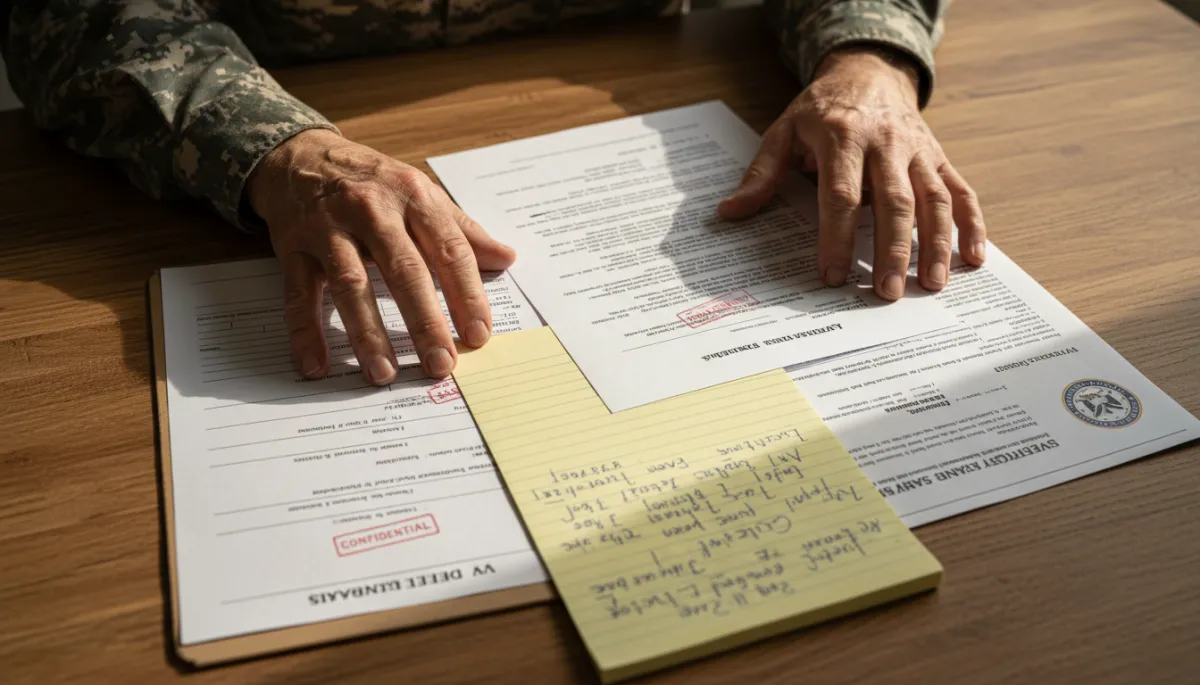
Close-up of a veteran’s hands in spreading out medical records, VA decision letters, and...
A clear paper trail from service to today forces the VA to see the full impact.
Consistency: Your Records All Tell the Same Story
Inconsistent documentation is a gift to the VA—an excuse to question your credibility or minimize your rating. If your medical records say one thing, your statements say another, and your exam reports say something else entirely, your claim approval odds drop. Consistency is non-negotiable. Your documentation, your statements, and your testimony should reinforce—not contradict—each other at every turn in the claim process.
Use the same description of your condition and symptoms across all forms
Make sure your doctors understand how your condition affects work, family, and daily activities
Review your records and correct errors through written statements or updated notes
Depth: Not Just “I Hurt,” but How, When, and How Often
Vague documentation leads to vague ratings. Saying “I’m in pain” is not enough. Saying “I have daily back pain rated 8 out of 10, with flare-ups that keep me from standing more than 10 minutes or lifting more than 10 pounds” is specific, measurable, and hard to ignore. The VA’s rating schedule is detailed; your documentation has to be just as detailed if you want the veteran benefits you’ve earned—not a watered-down version.
📌 Key Takeaway: The more specific your documentation, the more accurately the VA can (and must) rate your disability. Vague records equal vague compensation.
Documentation Importance in Appeals: Turning a No into a Yes
If your claim has already been denied or underrated, your instinct might be to feel defeated. Don’t. A denial is often just a loud signal that your documentation wasn’t strong enough the first time. The appeals process is where documentation can roar back and flip the decision in your favor—if you’re willing to sharpen it and fight back strategically.
Read the Decision. Attack the Weak Spots with Evidence.
The VA’s decision letter usually tells you why they said no—or why they lowballed your rating. Maybe they say there’s “no evidence of a nexus.” Maybe they claim your symptoms are “mild.” Maybe they insist there’s “no record of treatment in service.” Every one of those reasons is an opening for stronger documentation. If they say there’s no nexus, you get a nexus letter. If they say there’s no severity, you gather more detailed medical records. If they say there’s no in-service evidence, you dig for buddy statements or overlooked service records.
Use appeals to submit new and relevant documentation, not just re-argue your case
Focus your evidence on exactly what the VA said was missing
Consider working with an accredited representative to target your documentation more effectively
Appeals Are Won on Paper Long Before a Hearing
Even if you go before a judge or attend a hearing, the backbone of your case is still your documentation. Testimony matters, but it’s your records, reports, and letters that carry the legal weight. Judges and decision-makers are persuaded by patterns, timelines, and medical opinions, not just emotion. Build a file so strong that your hearing becomes a formality, not your only hope.
Veteran Benefits: What’s Really at Stake If You Ignore Documentation
This isn’t just about paperwork. It’s about your life. The quality of your documentation directly affects the quality of your veteran benefits—and those benefits are more than a monthly check. They’re access to healthcare, support for your family, housing advantages, education opportunities, and long-term security. Weak documentation doesn’t just cost you a little money; it can cost you years of stability and support you’ve already earned in uniform.
Higher disability ratings mean stronger financial protection for you and your family
Service-connected status can unlock priority VA healthcare access and specialized programs
Certain ratings open doors to additional benefits like Individual Unemployability, caregiver support, or education benefits for dependents
Every missing piece of documentation is a missed opportunity. Every strong piece of evidence is a step closer to the full benefits you deserve. Documentation is not busywork; it’s the engine that drives your claim approval and the key to unlocking the support you earned the hard way.
How to Take Control of Your Documentation—Starting Now
You don’t have to be a lawyer or a paperwork expert to build winning documentation. You just have to be deliberate, organized, and relentless. Here’s how to take control of your documentation and stack the deck in your favor throughout the VA claims process.
Build Your Own Evidence File
Don’t rely on scattered records and random envelopes. Create a dedicated binder or digital folder for your VA claims. Divide it into sections: service records, medical records, mental health records, lay statements, VA letters, and decisions. When you can see your case laid out clearly, you’ll immediately spot holes, contradictions, and opportunities to strengthen your file. Organization is not optional; it’s a weapon that puts you in control of your claim process instead of constantly reacting to it.
Turn Every Appointment into Evidence
Every time you see a doctor, therapist, or specialist, you have a chance to strengthen your documentation. Don’t downplay your symptoms. Don’t say “I’m fine” when you’re not. Be honest, detailed, and specific. Ask your providers to note how your condition limits your work, relationships, sleep, and mobility. Those notes become part of the official record—and the official record is exactly what the VA reads when deciding your claim approval.
💡 Pro Tip: After appointments, request copies of key visit summaries. Add them to your claim file. Don’t assume they’ll automatically show up where they’re needed.
Use Lay Statements to Fill in the Gaps
Not every part of your story will appear in medical or service records. That’s where lay statements—letters from you, your family, coworkers, or fellow veterans—become powerful documentation. They can describe changes in your behavior, your mood, your ability to work, and your daily struggles. When written clearly and consistently, these statements can fill gaps in the official record and give the VA a fuller picture of your reality.
Ask people who see you regularly to describe what they notice—not what they think the VA wants to hear
Focus on specific examples: missed work, panic attacks, physical limitations, or memory issues
Keep statements factual, honest, and free of exaggeration; credibility matters
The Bottom Line: Documentation Is Your Most Powerful Weapon
At every turn, from your first application to your final appeal, one truth never changes: documentation wins VA claims. Not luck. Not charm. Not frustration. Evidence. The importance of documentation is not theoretical—it’s practical, measurable, and brutally real. Strong documentation shapes how the VA sees your service, your injuries, your limitations, and your need for support. It drives claim approval, claim success, and ultimately the level of veteran benefits you receive.
You can’t change the past, but you can absolutely control how well it’s documented today. You can decide whether your claim file is thin and easy to dismiss—or thick, organized, and impossible to ignore. The VA system is far from perfect, but it does respond to one thing with consistency: solid, targeted, relentless documentation. If you’re willing to build that, you give yourself the best possible shot at the outcome you deserve.
📌 Final Call to Action: Don’t file another form or accept another denial without upgrading your documentation. Gather your records, organize your evidence, and treat your claim like the serious legal case it is. Your service was real. Your injuries are real. Make your documentation just as real—and force the VA to see it.
📌 Next Step: If you’re ready for expert help turning your records into a winning claim, visit www.warriorbenefits.com to get started.