
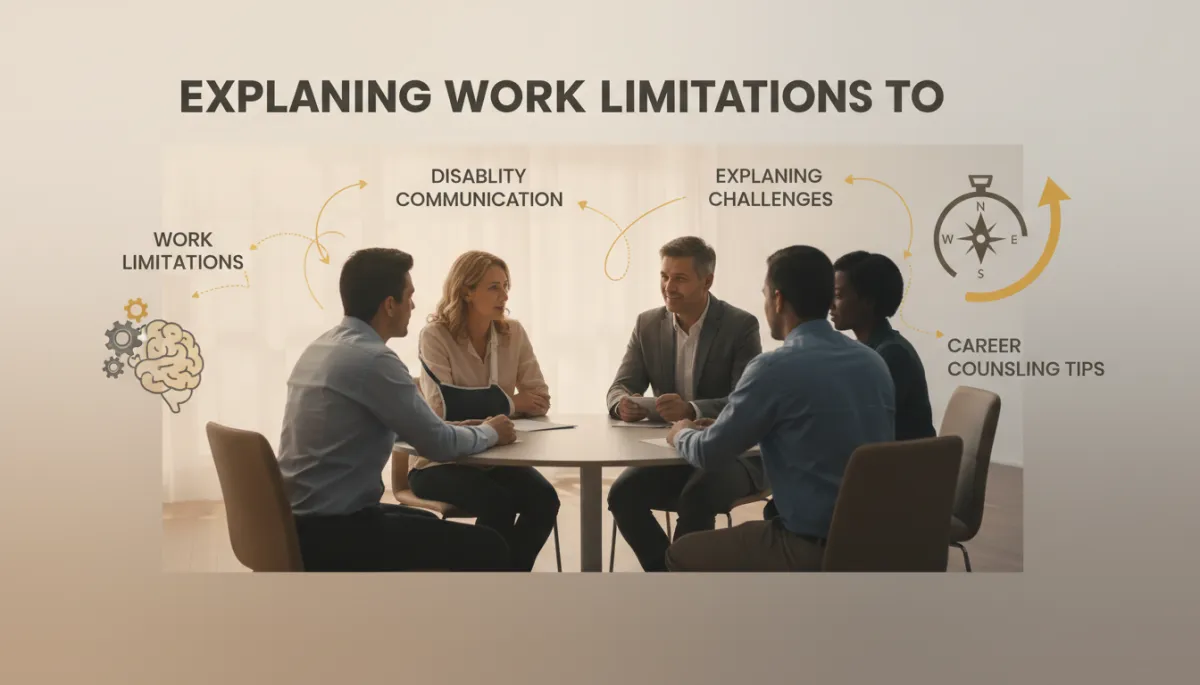
Explaining Work Limits to VR&E Counselors
Veterans, Vocational Rehabilitation, Career Counseling Tips
How to Explain Work Limitations to a VR&E Counselor
Navigating Vocational Rehabilitation can feel overwhelming, especially when you need to explain your work limitations to a VR&E Counselor. This guide walks you step-by-step through how to prepare, what to say, and how to advocate for yourself so your counselor clearly understands your abilities, challenges, and career goals.
Understanding the Role of a VR&E Counselor
A VR&E Counselor (Vocational Rehabilitation and Employment counselor) is your primary partner in the VA’s Vocational Rehabilitation program. Their job is to help you identify suitable careers, understand your work limitations, and connect you with training, accommodations, and support so you can prepare for, find, and maintain employment that fits your abilities and interests. They are not there to judge your disability or question your service; they are there to translate your situation into a realistic and supportive vocational rehabilitation plan.
When you meet with your counselor, they will ask about your medical history, functional abilities, education, work experience, and daily life. Clear, honest disability communication during these conversations helps them understand not only what you cannot do, but also what you can do, and under what conditions you work best. The more accurately you can describe your real limitations and strengths, the better they can support you with individualized career counseling tips and services.
What “Work Limitations” Really Mean
Many veterans feel uncomfortable talking about their limitations. It can feel like admitting weakness or fearing that you will be “disqualified” from opportunities. In the context of vocational rehabilitation, however, work limitations are simply the specific tasks, environments, or demands that are difficult or unsafe for you because of your service-connected or other disabilities. They are not character flaws or failures; they are practical facts that must be understood so that your VR&E plan is realistic and sustainable.
Work limitations can be physical, cognitive, emotional, or sensory. For example:
Physical: difficulty lifting more than a certain weight, standing or sitting for long periods, climbing stairs, or repetitive motions due to back, knee, or shoulder injuries.
Cognitive: challenges with concentration, memory, processing speed, or multitasking due to traumatic brain injury (TBI), medications, or mental health conditions.
Emotional or behavioral: difficulty managing stress, anxiety, irritability, or mood swings, especially in high-pressure or unpredictable environments.
Sensory: sensitivity to noise, crowds, bright lights, or certain triggers that may worsen PTSD symptoms or migraines.
When you talk to your VR&E Counselor, your goal is to turn these general categories into clear, concrete descriptions. This is the heart of effective disability communication and the foundation for explaining challenges in a way that leads to meaningful support and accommodations.
Preparing Before You Meet Your VR&E Counselor
Preparing in advance allows you to explain your work limitations calmly and accurately, without feeling rushed or caught off guard. Consider taking the following steps before your appointment as part of your overall vocational rehabilitation strategy.
1. List Your Symptoms and Daily Challenges
Start by writing down the symptoms you experience on a typical day and on a bad day. Be specific. Instead of “my back hurts,” describe how long you can sit, stand, or walk before the pain becomes severe. Instead of “I have anxiety,” note what situations trigger it and how it affects your ability to focus, interact with others, or complete tasks. This written list will be a valuable reference during the meeting and helps you avoid forgetting important details when you are under stress.
2. Connect Symptoms to Work Tasks
The key to explaining challenges in a vocational setting is connecting your symptoms to specific job-related tasks. Ask yourself:
What kinds of tasks are hard for me now that used to be easier?
How long can I realistically do certain activities (standing, typing, driving, concentrating) before I need a break?
Are there environments (noisy offices, crowded spaces, night shifts) that worsen my symptoms?
Turning symptoms into concrete work limitations is one of the most powerful career counseling tips you can apply. It helps your VR&E Counselor understand what types of work are realistic and what accommodations may be needed.
3. Gather Relevant Documentation
Bring copies of medical records, VA rating decisions, physical therapy notes, psychological evaluations, or any other documentation that explains your conditions and functional limits. While your counselor may already have access to some records, having them on hand allows you to reference specific findings when you are explaining challenges. Documentation also reinforces that your reported limitations are consistent with professional assessments.
4. Clarify Your Employment Goals and Priorities
Vocational rehabilitation is about more than what you cannot do; it is also about where you want to go. Before the meeting, think about:
What type of work interests you now?
What skills do you already have from the military or previous jobs?
What kind of schedule, environment, and physical demands would be ideal for you?
Being able to say, “Here are my limitations, and here are my goals,” allows the counselor to design a realistic, individualized plan that balances both sides of the equation.
📌 Key Takeaway: Preparation is part of effective disability communication. Written notes about symptoms, tasks, and goals make it easier to explain work limitations clearly and confidently.
How to Talk About Your Limitations: Practical Communication Strategies
Once you are in the meeting, it is normal to feel nervous or unsure how much to share. Using structured disability communication techniques can help you stay focused and professional while still being honest and thorough about your work limitations.
Use “I” Statements and Concrete Examples
Speak from your own experience using “I” statements, and back up your statements with specific examples. For instance:
Instead of: “My back is messed up.”
Say: “I can sit for about 20 minutes before my lower back pain reaches a 7 out of 10, and I need to stand or walk for a few minutes to reduce it.”
Instead of: “Crowds are a problem.”
Say: “When I am in crowded or noisy environments, my anxiety increases, and I start scanning constantly. After about 15 minutes, I have trouble focusing on what people are saying.”
These kinds of examples give your VR&E Counselor a clear picture of your functional limits and how they might affect different job settings. They also show that you have insight into your own condition, which is helpful for planning accommodations and training.
Describe Both “Good Days” and “Bad Days”
Many disabilities fluctuate. You may have days when you function relatively well and days when symptoms are much worse. Effective explaining challenges means talking about this range honestly. For example:
“On a good day, I can work at a computer for about four hours with breaks. On a bad day, my headaches are so severe that I can only tolerate about an hour of screen time, even with medication.”
This helps your counselor understand the consistency of your performance and what kind of flexibility you might need in a job or training program. It is a crucial part of vocational rehabilitation planning, because employment success depends not only on what you can do once, but on what you can sustain over time.
Be Honest About Invisible Disabilities
Conditions such as PTSD, depression, anxiety, TBI, and chronic pain are often invisible to others, which can make them harder to discuss. However, they can have a major impact on your ability to concentrate, interact with coworkers, or manage stress. When talking with your VR&E Counselor, focus on how these conditions affect your work-related functioning:
“I have trouble sleeping most nights, which makes it hard to stay alert early in the morning.”
“When I am startled by loud noises, it takes me a while to calm down and refocus on my tasks.”
Sharing these details is not complaining; it is essential disability communication that allows your counselor to consider roles, schedules, and environments that will set you up for long-term success.
Explain What Helps You Function Better
Effective career counseling tips focus not only on limitations, but also on strategies that improve your functioning. Tell your counselor what makes tasks easier or more manageable:
“If I can alternate between sitting and standing, my back pain is much more manageable.”
“Written instructions and checklists help me stay organized when my memory is not as sharp.”
“Quiet workspaces or noise-cancelling headphones reduce my anxiety and help me concentrate.”
These details guide your VR&E Counselor in recommending accommodations, training formats, and job types that align with your strengths and needs within the vocational rehabilitation process.

Written notes about symptoms and tasks make it easier to describe real work limitations accurately.
Framing Your Limitations in the Context of Vocational Rehabilitation
Vocational rehabilitation is about matching you with employment that is both achievable and meaningful. When you explain your work limitations, it helps to frame them in terms of how they affect your ability to prepare for, obtain, and keep a job. This perspective keeps the conversation focused on solutions and planning, rather than just symptoms.
Discuss Training and Education Tolerances
Your VR&E plan may involve college courses, technical training, or certifications. Be open about how your limitations might affect your ability to participate in these programs:
“Because of my migraines, I may need to take some courses online instead of in bright, crowded classrooms.”
“My concentration is better in the late morning and afternoon, so early morning classes are difficult for me.”
These details help your counselor design a training path that is realistic, allowing you to progress without constant setbacks due to unmanaged work limitations.
Talk About Job Retention, Not Just Job Placement
Getting a job is only part of the goal; keeping that job in a healthy and sustainable way is equally important. When explaining challenges, consider how your limitations might affect long-term employment:
“In the past, I left jobs because the physical demands aggravated my injuries over time.”
“When my PTSD symptoms flare up, I sometimes call in sick because I cannot handle crowded or chaotic environments.”
This kind of honest disability communication gives your VR&E Counselor insight into why past jobs may not have worked and what needs to change in future roles. It allows them to tailor career counseling tips and supports that improve your chances of long-term success.
Balancing Limitations with Strengths and Interests
While it is essential to be clear about your work limitations, your VR&E counselor also needs to understand your strengths, interests, and values. A strong vocational rehabilitation plan is built at the intersection of what you can do, what you want to do, and what the labor market needs.
Highlight Transferable Skills from Military Service
Many veterans underestimate the value of their military skills. Leadership, teamwork, problem-solving under pressure, logistics, technical expertise, and communication are all highly transferable. When explaining challenges, balance them with statements such as:
“Although I cannot do heavy physical work anymore, I have strong experience supervising teams and coordinating operations.”
“I may need a quieter work environment, but I am very detail-oriented and reliable with paperwork and documentation.”
This approach shows your counselor that you are focused on possibilities, not just barriers, and helps them suggest career paths that honor both your service and your current abilities.
Clarify What Motivates You in a Career
As you discuss your limitations, also talk about what matters most to you in a job. For example, you might say:
“I want a career where I can help others, but I need a predictable schedule to manage my medical appointments.”
“I am interested in technology and would like a role that allows me to work with computers in a relatively quiet environment.”
These statements give your counselor context for your limitations and help them provide targeted career counseling tips that align with your values and lifestyle.
💡 Pro Tip: Think of your VR&E meeting as a professional planning session. Present your work limitations, strengths, and goals with the same clarity you would bring to a mission briefing.
Handling Difficult Emotions While Explaining Challenges
Discussing injuries, trauma, and work limitations can bring up frustration, grief, or anger. These emotions are understandable, but you may worry that they will interfere with your ability to communicate clearly. A few strategies can help you stay grounded during your conversation with your VR&E Counselor.
Practice ahead of time. Consider rehearsing what you want to say with a trusted friend, family member, or mental health provider. Practicing your disability communication can reduce anxiety and help you find the right words.
Use your notes. If you become emotional, you can refer back to your written list of symptoms, examples, and questions. This keeps the conversation focused even when it feels difficult.
Ask for a pause if needed. It is acceptable to say, “I need a moment,” or “This is hard to talk about; can we take a short break?” Your counselor understands that these topics can be painful.
Remember that your emotions do not disqualify you from services. They are part of your experience, and your willingness to show up and explain your situation is a strength in itself.
Following Up: Keeping Communication Open with Your VR&E Counselor
Explaining your work limitations is not a one-time event. As you move through training, job search, or employment, your needs may change. Ongoing, honest disability communication with your VR&E Counselor helps ensure your plan continues to fit your reality.
Report changes in your condition. If your symptoms improve or worsen, let your counselor know. Adjustments to your plan may be necessary to keep you on track.
Share feedback about accommodations. If certain supports are working well—or not working at all—communicate that clearly. This information guides future decisions and can lead to more effective solutions.
Ask questions. If you are unsure why a particular step is recommended, or if you think a different approach might work better given your limitations, ask. Your counselor is there to collaborate with you.
This ongoing dialogue is a core part of effective vocational rehabilitation. It ensures that your plan remains realistic, respectful of your work limitations, and aligned with your long-term career goals.
Putting It All Together: A Sample Script for Explaining Work Limitations
To make these concepts more concrete, here is an example of how you might bring everything together when speaking with your VR&E Counselor. You can adapt this to fit your own circumstances:
“Because of my back injury and PTSD, I have several work limitations I need to share. Physically, I can sit for about 20–30 minutes before my pain increases to the point where I need to stand or walk for a few minutes. I cannot safely lift more than 20 pounds repeatedly. On a good day, I can work at a computer for about four hours with regular breaks; on a bad day, my pain and headaches reduce that to about two hours.
My PTSD and anxiety are triggered by loud, chaotic environments and crowds. When that happens, I become very tense and hyperalert, and it is hard for me to focus on tasks or conversations. Quiet, structured workspaces help me function much better. Written instructions and checklists are also very helpful when my concentration is low.
Even with these limitations, I have strengths I want to use. In the military, I developed strong skills in logistics, planning, and supervising small teams. I am interested in pursuing a career in office-based logistics or operations, ideally in an environment that is relatively quiet and predictable. I am open to training or college courses, but I may need some flexibility with class formats and schedules because of my pain and sleep issues.
This script integrates clear disability communication, specific work limitations, and realistic goals. It gives your counselor the information they need to provide targeted career counseling tips and build a vocational rehabilitation plan that fits your life.
Final Thoughts: Advocating for Yourself with Professional Clarity
Learning how to explain work limitations to a VR&E Counselor is a key step in making the most of vocational rehabilitation. It requires honesty, preparation, and the willingness to talk about difficult experiences in a professional way. By preparing written notes, using clear examples, describing both good and bad days, and connecting your limitations to specific job tasks, you transform your story into practical information your counselor can use to help you.
Remember that you are not asking for special treatment; you are providing the details necessary for a fair, realistic assessment of your capabilities. Effective disability communication is an act of self-advocacy that protects your health, honors your service, and positions you for meaningful, sustainable employment. When you approach your VR&E meetings with this mindset—and when you work collaboratively with your counselor—you increase the chances that your career path will reflect both your strengths and the realities of your work limitations.
As you move forward, continue to apply these career counseling tips: communicate openly, document your experiences, and stay engaged in the planning process. By doing so, you turn a challenging conversation into a powerful tool for building the next chapter of your professional life with clarity, dignity, and purpose.
📌 Ready for one-on-one support? If you want help preparing for your VR&E meeting, organizing your limitations, or planning your next career steps, visit PathfinderBenefits.com to explore personalized guidance and veteran-focused resources.