

Effective Buddy Statements for VA Claims
VA Claims, Buddy Statements, Veterans Benefits
Buddy Statements for VA Claims: What Makes Them Truly Effective?
When you step into the arena of VA Claims, you are not walking in quietly—you are fighting for the benefits you earned. Buddy Statements can be one of the sharpest weapons in your arsenal, but only if they are done right. This guide breaks down exactly what makes a Buddy Statement powerful, persuasive, and impossible for the VA to ignore.
Why Buddy Statements Matter More Than You Think
The VA system is driven by evidence, not assumptions. If something is not clearly documented, it may as well not exist in the eyes of a rater. That is where Buddy Statements come in. They transform your military experiences—from combat injuries to daily duties to gradual mental health changes—into Effective Documentation anchored in Personal Testimony from people who were actually there with you.
Maybe your injury never made it into your service treatment records. Maybe your PTSD symptoms did not get reported because you pushed through and stayed quiet. Maybe you were in a unit where “suck it up” was the norm. The VA may not see the full truth on paper—unless your fellow service members, family, or close friends put it there through strong, detailed Buddy Statements that back your claim with undeniable, real-world perspective.
📌 Key Takeaway: If your records are thin, unclear, or missing, a powerful Buddy Statement can bridge the gap between doubt and approval on your VA Claim.
What Exactly Is a Buddy Statement in a VA Claim?
A Buddy Statement—often written on VA Form 21-10210 (Lay/Witness Statement)—is a written Personal Testimony from someone who has firsthand knowledge of your condition, incident, or symptoms. This is not a casual note; it is sworn evidence that becomes part of your official VA Claims file. The writer is essentially telling the VA, “I was there. I saw this. This is what happened, and this is how it affected them.”
Who can write one? Fellow service members, supervisors, subordinates, roommates, spouses, partners, siblings, parents, adult children, coworkers, or close friends—anyone with direct, credible knowledge of your situation.
What does it support? Service connection, increased rating, secondary conditions, or continuity of symptoms after service.
Why does the VA care? Because lay evidence—when specific and credible—can fill the holes that medical records and official logs leave behind.
💡 Pro Tip: The VA is allowed to accept lay evidence as proof of in-service events and ongoing symptoms. A sharp Buddy Statement is not “extra”—it is strategic evidence.
The Core Elements of an Effective Buddy Statement
Not all Buddy Statements are created equal. Some are vague, weak, and easy to dismiss. Others are bold, detailed, and impossible to ignore. If you want a Buddy Statement that actually moves the needle on your VA Claim, it must hit several critical marks. Think of these as non-negotiable ingredients in Effective Documentation.
1. Clear Identification of the Writer and Their Relationship to You
The VA needs to know exactly who is talking and why their voice matters. A strong Buddy Statement starts with clarity:
Full name, contact information, and if applicable, rank and unit at the time of service.
A brief explanation of how they know you (same platoon, shared barracks, spouse during deployment, coworker after discharge, etc.).
This is not filler—it is foundation. The stronger the connection, the stronger the Personal Testimony appears in the eyes of the VA rater.
2. Specific Dates, Locations, and Context
Vague statements are weak statements. “He got hurt sometime in Iraq” is soft. “On or about March 2007, in Ramadi, Iraq, during a night patrol…” is strong. The more concrete the details, the more the VA can connect the dots between your claim, your service, and your current condition.
Include approximate dates (month and year at minimum).
Name the base, city, or deployment area if possible.
Describe the mission, duty, or daily situation surrounding the event or symptoms.
3. Concrete, Firsthand Observations—Not Guesswork
The most effective Buddy Statements are grounded in what the writer personally saw, heard, or experienced. The VA does not want speculation; it wants observations. “I saw,” “I heard,” “I noticed,” and “I was present when” are powerful phrases that anchor the testimony in reality.
⚠️ Warning: Statements like “I think his back problems are from…” or “I believe she has PTSD because…” are weaker. The writer is not a doctor. They should focus on what they witnessed, not medical conclusions.
4. A Direct Connection to the VA Claim Being Filed
A Buddy Statement is not a character reference. The VA is not rating your personality; it is rating your disability. The testimony must connect directly to the condition or event you are claiming—whether it is a knee injury, hearing loss, migraines, depression, or anything else tied to your service.
If you are filing for PTSD, the statement should describe the stressor event and changes in your behavior or mood afterward.
If you are filing for a back injury, it should describe the incident, the immediate impact, and any visible limitations that followed.
5. Evidence of Ongoing Impact—Not Just a One-Time Event
The VA rates disabilities based on how they affect your day-to-day life. An effective Buddy Statement does not stop at “he got hurt.” It goes further: “After that day, he could not run like before,” or “She stopped sleeping through the night and became jumpy at loud noises.” This kind of detail turns raw events into compelling Effective Documentation of functional loss and ongoing symptoms.
Who Should You Ask to Write a Buddy Statement?
You are not begging for favors—you are building a case. You want people whose voices carry weight because they actually saw what you went through. Think strategically about who can deliver the strongest Personal Testimony to support your VA Claim.
Fellow Service Members and Supervisors
These are often your heaviest hitters. A squadmate who carried you off the truck, a platoon sergeant who reassigned you because of your injury, or a shipmate who watched your hearing deteriorate on the flight deck—all of them can give the VA a front-row seat to your reality. Their Buddy Statements can directly link your condition to your service in a way that dry records rarely do.
Spouses, Partners, and Family Members
Your family sees what the VA does not: the nightmares, the pain, the mood swings, the missed events, the days you cannot get out of bed. They can describe how your condition has changed your behavior, relationships, and daily functioning over time. For mental health, chronic pain, sleep issues, and many long-term conditions, this kind of lay evidence is incredibly powerful.
Friends, Roommates, and Coworkers After Service
These people help prove continuity—how your symptoms followed you home and into civilian life. A roommate who watched you pace at 3 a.m., a coworker who saw you miss shifts from migraines, or a friend who noticed you withdrawing from social events can all provide Effective Documentation of your ongoing struggles long after discharge.
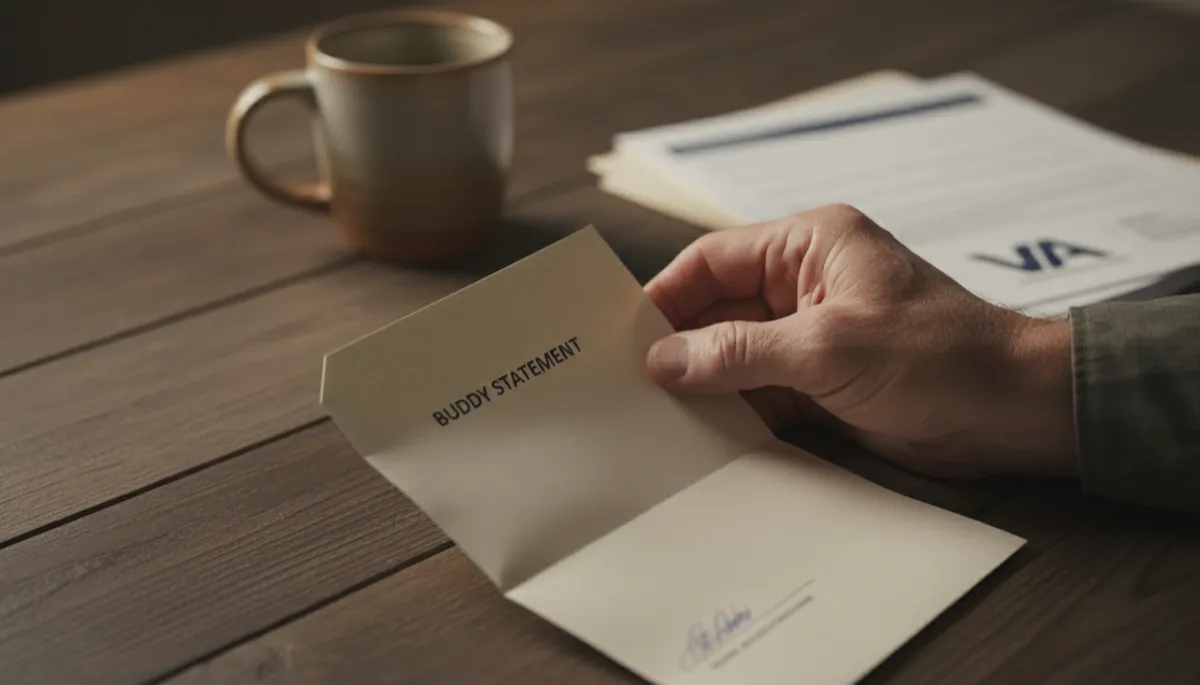
A clear, detailed buddy statement can tip a borderline VA claim firmly in your favor.
How to Guide Someone to Write a Strong Buddy Statement (Without Telling Them What to Say)
You cannot script someone’s words, and you should not. The VA wants honest testimony, not a rehearsed performance. But you can absolutely guide your buddy, spouse, or coworker so their statement is organized, focused, and effective. Here is a bold, simple structure you can suggest:
Introduction: Who they are, how they know you, and for how long.
In-Service or Post-Service Observations: What they personally witnessed—events, symptoms, changes in your abilities or behavior.
Specific Examples: At least two or three concrete, detailed situations that show the problem clearly.
Current Impact: How your condition affects your daily life now—work, relationships, sleep, mobility, or mental health.
Closing: A clear statement that they swear the information is true to the best of their knowledge and a signature with the date.
💡 Pro Tip: Give your buddy a summary of what you are claiming and why. Let them know the timeframe and events you remember. Then let them use their own words to back you up with their Personal Testimony.
Examples: Weak vs. Strong Buddy Statements
Weak Statement: Easy to Dismiss
“I served with John in Iraq. He hurt his back over there and has had problems ever since. He is a good guy and deserves benefits.”
This sounds supportive, but it is soft. No dates, no details, no clear description of what actually happened or how it affects John now. The VA can read this and shrug.
Strong Statement: Hard to Ignore
“My name is Staff Sergeant Mark Davis (USMC, retired). I served with Corporal John Smith in 2nd Battalion, 7th Marines, from 2006 to 2008. In October 2007, while we were deployed to Helmand Province, Afghanistan, I personally witnessed John injure his back. During a night patrol, our vehicle hit an IED, and John was thrown hard against the interior of the MRAP. After the blast, he complained of severe lower back pain and had difficulty standing upright.
Over the following weeks, I observed John struggle to carry his full combat load. He frequently asked others to help with heavy lifting, and I saw him grimace and stretch his back multiple times a day. He told me that medical was limited, and he did not want to be pulled off patrols, so he tried to push through the pain. Since our return from deployment, I have stayed in contact with John. He has told me that his back pain has continued and that he can no longer run or exercise like he did before the blast.
I swear that the above statements are true to the best of my knowledge and recollection.”
This is bold, detailed, and anchored in firsthand observation. It is not just support—it is Effective Documentation that directly reinforces the VA Claim.
Common Mistakes That Weaken Buddy Statements (And How to Avoid Them)
Being too vague: Avoid “sometime,” “somewhere,” or “he had issues.” Replace them with specific timeframes, locations, and descriptions of what actually happened.
Acting like a doctor: Your buddy should not diagnose you. They should describe what they saw—limping, panic attacks, hearing difficulty, insomnia—not label it medically.
Writing a character reference instead of evidence: “He is honest and hardworking” does not prove a disability. Focus the statement on events, symptoms, and impact, not personality traits.
Copy-paste language: If every Buddy Statement in your file sounds identical, it looks rehearsed and less credible. Each person should speak in their own natural voice.
Leaving out the present-day impact: The VA wants to know how you are doing now. Make sure at least part of the statement describes your current limitations or symptoms.
How Buddy Statements Fit Into the Bigger Picture of Effective Documentation
Buddy Statements do not replace medical evidence—but they absolutely reinforce it. Think of your VA Claim as a case you are building. Medical records, service treatment records, and C&P exams are one side of the story. Your Personal Testimony and the testimony of those around you are the other side. When both sides line up, your claim becomes extremely hard to deny.
For service connection, Buddy Statements can prove that an in-service event or injury actually occurred—even if it never made it into your official records.
For an increased rating, they can highlight how your symptoms have worsened or how your functioning has declined over time.
For secondary conditions, they can show how one service-connected issue led to another—like chronic pain leading to depression, or knee problems leading to back pain.
📌 Key Takeaway: Do not treat Buddy Statements as an afterthought. Treat them as core evidence. When combined with medical records and your own statement, they create a bold, unified narrative the VA cannot easily ignore.
Practical Steps to Use Buddy Statements in Your VA Claim Right Now
Identify the gaps in your evidence. Look at your claim: Where are the weak spots? No record of the in-service event? Limited mental health notes? That is exactly where Buddy Statements can hit hardest.
Make a list of potential witnesses. Think back to your unit, your barracks, your deployments, your home life, and your work life. Who saw the event? Who saw the changes in you? Who sees your struggles now?
Reach out clearly and confidently. Explain that you are filing or appealing a VA Claim, and their honest statement could make a real difference. You are not asking them to lie—you are asking them to tell the truth with clarity and detail.
Share the structure—not the script. Give them a suggested outline and the timeframe or events you remember, then let them write in their own words. Authenticity matters.
Submit the statements properly. Use VA Form 21-10210 when possible, attach the Buddy Statements to your claim or supplemental claim, and clearly label which condition or issue each statement supports.
Your Story Deserves to Be Heard—Loud and Clear
You did not serve quietly. You should not have to fight for your benefits quietly either. Buddy Statements give volume and weight to your Personal Testimony. They turn memories into Effective Documentation and transform your VA Claim from a thin stack of papers into a bold, fully backed story of what really happened and how it still affects you today.
If your records are incomplete, if your injuries were underreported, if your mental health struggles stayed in the shadows during service—do not assume you are stuck. Bring in the people who walked beside you: your battle buddies, your leaders, your family, your friends. Their words can bridge the gap between doubt and recognition, between denial and the benefits you have earned.
Stand firm. Be strategic. Use every tool available—including sharp, detailed Buddy Statements—to make your VA Claim impossible to overlook. Your service was real. Your injuries are real. Your story deserves to be documented boldly, clearly, and completely—and you do not have to tell it alone.
✅ Next Step: If you want expert help strengthening your VA claim and using buddy statements the right way, visit www.warriorbenefits.com to get started today.